Discussion Reports
Making Change Through Institutions and Archival Spaces
10 June, 2020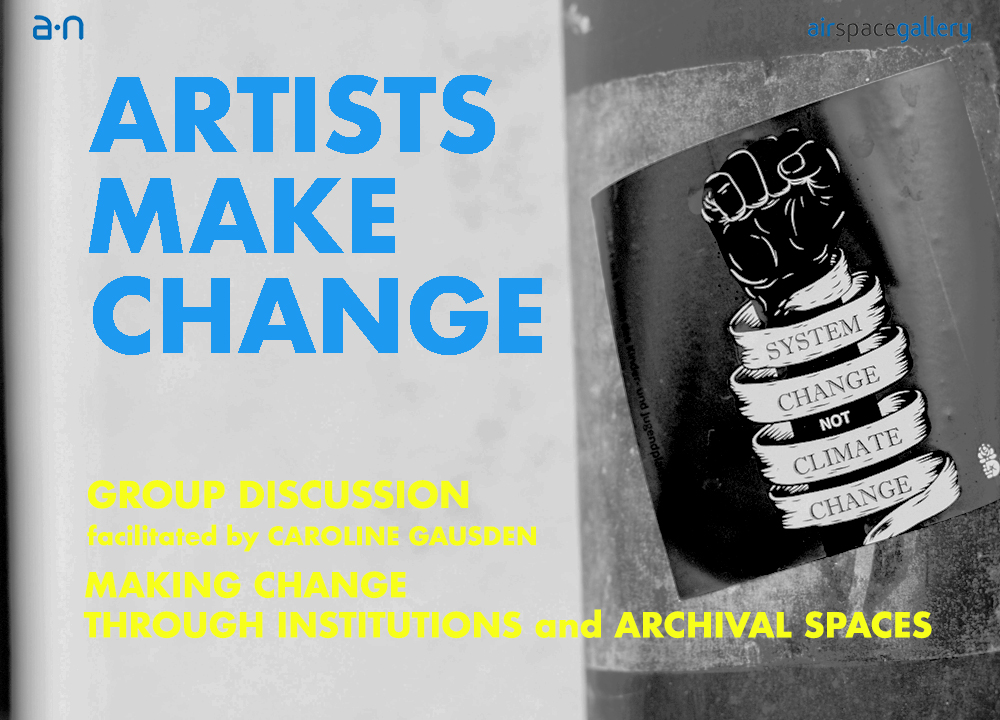
DISCUSSION #3
Making Change through Institutions and Archival Spaces
facilitated by Caroline Gausden
June 12th 2pm - 3.30pm
In response to the 5 video case study presentations, we are holding a series of group discussions to explore the themes of the presentations in more detail. Making Change through Institutions and Archival Spaces was a discussion facilitated by Glasgow Women's Library's Caroline Gausden, whose duties with the GWL cover activism, engagement, archives, curatorial work and research.
REPORT DOWNLOAD (pdf)
OUTSET
The aims and intended areas to cover were:
THOUGHTS EMANATING
In her initial introduction to herself and Glasgow Women's Library (GWL), Caroline covered specific areas and raised issues that would inform the discussion. These included the ideas of how GWL operates as :
● a feminist manifesto, with the desire to make change in the world.
● a space to champion women's history and creativity through a broad range of materials
based on this miss ion. It's not based on a narrow vision of women's history and what culture is . Adele Patrick calls it a ‘collective visioning process ’ - an archive made of exclusively donated books and created by a collective voice.
● an inclusive space - anyone interested in exploring histories is welcome in this space. Sometimes , in order to create intimate settings , GWL hosts events for specific groups - eg women only events that are trans-inclusive & hosted by skilled facilitators.
● a hybrid & multi -faceted space - it's a library and archive and a space for exhibitions .
● a counter cultural voice - a grass roots reaction working against a 1990's vision of the arts in
Glasgow & Scotland as ‘Stale, Male, Pale’.
● an institution that feels like a community archive - with 100 women volunteering alongside staff.
● working locally, nationally & internationally - both inside & beyond the walls of the library, hosting
people from different countries, with a sister organisation in Hamburg.
● a space that prioritises kindness, considering intersecting needs and making people feel welcome - Adrienne Maree Brown (American author, doula, women's rights activist and black feminist) is really influential to Caroline's and Adele’s thinking. Showing care is important - described as meeting differences with equality in mind.
● an organisation that uses its core values as an important way of holding things together - whereas other museums might programme and then add on inclusions after, for GWL it is something considered by the whole team at the start.
Caroline quoted from Adele Patrick’s Feminist Leadership Demands, including:
● Demand 3 - Appreciate & promote the fact that Women of Colour, B lack Feminists and women from the Global South are in the vanguard of understanding and modelling Feminist Leaders hip E nsure that their knowledge, work and histories are acknowledged and centred.
● Demand 4 - Honour, cite and bring to the fore other Feminist Elders and appreciate how I/we can learn from the knowledge, honesty and kindness of women, non-binary and trans people of all ages.
● Demand 5 - Make sure y/our professional and personal ‘go to’ people include those who know most about how it feels to be righteously angry and marginalised.
● Demand 6 - Advocate for and practice kindness.
● Demand 19 - Trust your vision and be brave.
Questions for the Discussion
● What makes an artist an activist?
○ What are the core values that people see in their practice?
● How does the idea of an archive fit into your work? ○ How are you archiving your work?
○ When is an archive an activist space?
● How we decide what kind of forms our organising is going to take? The term is 'non-hierarchical informality'.
○ What role is friendship playing and what other models do we look to?
○ What can we learn from the past?
● How can art schools as institutions make change?
● In relation to this question of ‘what is institution’? Is it a bad word?
○ Do we work with this or against this?
------------------------
BREAKOUT ROOMS
In this session, we used breakout rooms to discuss topics & questions offered. Not all of this discussion was recorded, s o what follows are the key areas brought back into the main discuss ion with the group. Themes and questions arising included:
● How to engage audiences in archives - what are the barriers and how can audiences in archives be facilitated?
● How to archive your own work?
● Is the term activist used too frequently? Has it become fashionable to use but nobody understands
why they are saying it? Is it just trendy or is activist a term that has real value?
● What is the relations hip between the archive and the artist? What responsibilities does the artist
have when archiving collections or working with archives ?
● How does archival work express itself as activism within museum/gallery heritage?
● Is there freedom to tell narratives through the archive that might be different from the institution's
view? The artist being able to tell in their own voice.
● Artists' non-institutional status allows objective approach to archive - the ability to critique an archive in a way that staff members , or guardians might be unable to or not comfortable with.
● Artists can be activists in the way they choose to work with archives - They can highlight parts of the collection that may have been ignored - so as an artist you have that possibility of being able to reframe a collection.
● Artists can find the gaps and highlight the gaps in collections
● Artists by nature are very curious people and ask questions and want to challenge in a very gentle way the way things are being done.
● Do artists organise as groups? Or do they organise as individuals hoping to enlist followers?
● Artists often talk about themselves as individuals but maybe it could be more about a relationship of collective bodies ? There's an interest in the relations hip between the two as they seem very different.
----------
● How to make political work with communities? And then how to do that in consultation with local galleries/councils /institutions? Often seen as vanguard activity - but in reality is fairly basic engagement activity.
● How to organis e and develop, in a pragmatic way, from a small group of interested people into a much larger group of politically-activated people
● How does 'the past' and the archive feed into activis t artwork?
● A quote from Lucy Lippard - “The feminist (and socialist) value system insists upon cultural workers supporting and responding to their constituencies. The three models of such interaction are: (1) group and/or public ritual; (2) public consciousness-raising and interaction through visual images, environments, and performances; and (3) cooperative/collaborative/collective or anonymous art making.”
---------------
● How can art schools make change?
● Art schools are much more running like businesses - that creates its own difficulties?
● Can different modes of working and alternative art school systems make change?
● Art schools often promote solo practices - how can collective practices fit in within an institutional
system?
● How do we work with artist's legacies?
● How do we activate histories within a heritage context? How can we play with those - to what
extent?
---------------
● What is Archive?
● Artists activate archives
● As artists we are 'hoarders' always keeping our own material and banks of research to return to to make work. Lockdown has offered some a chance to revisit old work and old research.
● Do we need an archive or access to one to make relevant contemporary work?
● How do we keep the archive active or past works/projects active?
● The politics of physical space when working collectively - does a collective need to be housed in
one physical space?
● The importance of self-governing at a time when there's a perception that central government can't
be relied on.
---------------
GROUP DISCUSSION
● How are practices archived?
○ What about archives and resources such as the internet? Is it important to actually go into a space and touch the archive and feel different histories?
○ What is the future of archiving?
○ How can artists work on other artists' work?
●Storage is an issue - artists' and collective's accrued work and ephemera can be difficult to store - a need for lots of physical space - what do you throw away?
○ Documentation is key - photographs and social media as storage.
● How do you keep those histories that might have been ignored? (eg feminist histories in a patriarchal world) - or practices that don't lend themselves to be easily archived - costumes etc. Performing the costumes and capturing/documenting the performance is a clear way.
● Array talked about how in the beginning they were acting individually but collectively without an understanding of their collective action - lots of early activity went undocumented because of this. The archive lost. As the group developed, the materials built up.
● As artists/ activists, it's important to be working quite urgently and responding to things very quickly. So, does it not then become quite impossible to archive - while you're so active?
● It feels odd to return to 10-year old work - so it's very helpful if someone has set up a library - or someone external to you can take the work and contextualise it. But this then is read through a third party which can change the intent of the work?
●Archives can change work’s intent, once the work starts a relationship with other work - At GWL, everything is donated, it's a mix of what people believe about women's history. There are gaps. So, we say we are not a total authority. Artists coming in and pointing out those gaps is something we are massively open to. If there is a piece of history you feel is vital should be here, then, yes, we take it.
Q. At what point does work become archival?
A. Work is archival from the point you thought about the creation of the work.
● "When I am at work, I am thinking how do I structure that within the records, describe it and make it accessible for future generations one of the questions: What kind of records are artists preserving their knowledge? You can't keep everything, because also people have big sculptures, so something being preserved in text, is that enough for you? Enough context for individuals to get an understanding of your work. A really good collection is preserving the provenance of y our work. If you are really good at preserving your artwork you can preserve it for future generations."
● Raising an idea of the ‘uncomfortable archive’ - Artists working with archival material and collections are inclined to tell stories that the institutions don't necessarily want to be told - creating a view which maybe does not fit the dominant archive narrative .
● For GWL it's important that material doesn’t exist in silos - it's always available and individual curators with different perspectives are encouraged to pick things out - this keeps the archive diverse - it's a representative collection with core values, but it's always important to ask, who we can ask in to reflect on those materials so we keep getting different voices and perspectives to reflect on the archive. This is an ongoing activity. It then becomes a collection of related knowledge rather than a narrative.
Important - it's not only how you archive work, but how easy is it to find? How do we help people find the material?
● Example shared by Emma from Array who accessed some work from photographers in the British Museum - and was the first person who ever accessed them - They'd been there 20 years.
● Quite a lot of The Women's Arts Slide Library in Goldsmith's is unknown and unreachable
● And how do we help people use the material once they find it? It's very difficult to reproduce or work with archival material due to copyright issues.
Reactivating archives. Informing your future work, informing your past, but also that idea that everything is current. There is nothing about the past in a way that does not inform our future.
● An archive is like a mirror
● Archiving is not forgetting what we have done, what people / cultures have done.
Q Who's in control of the archive? Particularly big societal archives - how can we use the collections to reflect society today in the present?
● And then thinking about “what does a collection of the future look like?”
● What would we collect now to make that collection? If an archive acts as a mirror, how does it
reflect our thinking? Often, collections don't reflect the communities. There are gaps. Historically it has been a white privileged, often male lens that creates th e archive. An artist can change that - position/lens and is able to see something else within these collections - there so often are so many amazing stories to tell.
Making Change through Institutions and Archival Spaces
facilitated by Caroline Gausden
June 12th 2pm - 3.30pm
In response to the 5 video case study presentations, we are holding a series of group discussions to explore the themes of the presentations in more detail. Making Change through Institutions and Archival Spaces was a discussion facilitated by Glasgow Women's Library's Caroline Gausden, whose duties with the GWL cover activism, engagement, archives, curatorial work and research.
REPORT DOWNLOAD (pdf)
OUTSET
The aims and intended areas to cover were:
– effective campaigns and protests
– the challenges of working in campaign and protest
– does campaigning and protesting really achieve change?
– how to bring the campaign into the Institution
– does the institution have a role to play in campaign and protest work?
– the challenges of working in campaign and protest
– does campaigning and protesting really achieve change?
– how to bring the campaign into the Institution
– does the institution have a role to play in campaign and protest work?
THOUGHTS EMANATING
In her initial introduction to herself and Glasgow Women's Library (GWL), Caroline covered specific areas and raised issues that would inform the discussion. These included the ideas of how GWL operates as :
● a feminist manifesto, with the desire to make change in the world.
● a space to champion women's history and creativity through a broad range of materials
based on this miss ion. It's not based on a narrow vision of women's history and what culture is . Adele Patrick calls it a ‘collective visioning process ’ - an archive made of exclusively donated books and created by a collective voice.
● an inclusive space - anyone interested in exploring histories is welcome in this space. Sometimes , in order to create intimate settings , GWL hosts events for specific groups - eg women only events that are trans-inclusive & hosted by skilled facilitators.
● a hybrid & multi -faceted space - it's a library and archive and a space for exhibitions .
● a counter cultural voice - a grass roots reaction working against a 1990's vision of the arts in
Glasgow & Scotland as ‘Stale, Male, Pale’.
● an institution that feels like a community archive - with 100 women volunteering alongside staff.
● working locally, nationally & internationally - both inside & beyond the walls of the library, hosting
people from different countries, with a sister organisation in Hamburg.
● a space that prioritises kindness, considering intersecting needs and making people feel welcome - Adrienne Maree Brown (American author, doula, women's rights activist and black feminist) is really influential to Caroline's and Adele’s thinking. Showing care is important - described as meeting differences with equality in mind.
● an organisation that uses its core values as an important way of holding things together - whereas other museums might programme and then add on inclusions after, for GWL it is something considered by the whole team at the start.
Caroline quoted from Adele Patrick’s Feminist Leadership Demands, including:
● Demand 3 - Appreciate & promote the fact that Women of Colour, B lack Feminists and women from the Global South are in the vanguard of understanding and modelling Feminist Leaders hip E nsure that their knowledge, work and histories are acknowledged and centred.
● Demand 4 - Honour, cite and bring to the fore other Feminist Elders and appreciate how I/we can learn from the knowledge, honesty and kindness of women, non-binary and trans people of all ages.
● Demand 5 - Make sure y/our professional and personal ‘go to’ people include those who know most about how it feels to be righteously angry and marginalised.
● Demand 6 - Advocate for and practice kindness.
● Demand 19 - Trust your vision and be brave.
Questions for the Discussion
● What makes an artist an activist?
○ What are the core values that people see in their practice?
● How does the idea of an archive fit into your work? ○ How are you archiving your work?
○ When is an archive an activist space?
● How we decide what kind of forms our organising is going to take? The term is 'non-hierarchical informality'.
○ What role is friendship playing and what other models do we look to?
○ What can we learn from the past?
● How can art schools as institutions make change?
● In relation to this question of ‘what is institution’? Is it a bad word?
○ Do we work with this or against this?
------------------------
BREAKOUT ROOMS
In this session, we used breakout rooms to discuss topics & questions offered. Not all of this discussion was recorded, s o what follows are the key areas brought back into the main discuss ion with the group. Themes and questions arising included:
● How to engage audiences in archives - what are the barriers and how can audiences in archives be facilitated?
● How to archive your own work?
● Is the term activist used too frequently? Has it become fashionable to use but nobody understands
why they are saying it? Is it just trendy or is activist a term that has real value?
● What is the relations hip between the archive and the artist? What responsibilities does the artist
have when archiving collections or working with archives ?
● How does archival work express itself as activism within museum/gallery heritage?
● Is there freedom to tell narratives through the archive that might be different from the institution's
view? The artist being able to tell in their own voice.
● Artists' non-institutional status allows objective approach to archive - the ability to critique an archive in a way that staff members , or guardians might be unable to or not comfortable with.
● Artists can be activists in the way they choose to work with archives - They can highlight parts of the collection that may have been ignored - so as an artist you have that possibility of being able to reframe a collection.
● Artists can find the gaps and highlight the gaps in collections
● Artists by nature are very curious people and ask questions and want to challenge in a very gentle way the way things are being done.
● Do artists organise as groups? Or do they organise as individuals hoping to enlist followers?
● Artists often talk about themselves as individuals but maybe it could be more about a relationship of collective bodies ? There's an interest in the relations hip between the two as they seem very different.
----------
● How to make political work with communities? And then how to do that in consultation with local galleries/councils /institutions? Often seen as vanguard activity - but in reality is fairly basic engagement activity.
● How to organis e and develop, in a pragmatic way, from a small group of interested people into a much larger group of politically-activated people
● How does 'the past' and the archive feed into activis t artwork?
● A quote from Lucy Lippard - “The feminist (and socialist) value system insists upon cultural workers supporting and responding to their constituencies. The three models of such interaction are: (1) group and/or public ritual; (2) public consciousness-raising and interaction through visual images, environments, and performances; and (3) cooperative/collaborative/collective or anonymous art making.”
---------------
● How can art schools make change?
● Art schools are much more running like businesses - that creates its own difficulties?
● Can different modes of working and alternative art school systems make change?
● Art schools often promote solo practices - how can collective practices fit in within an institutional
system?
● How do we work with artist's legacies?
● How do we activate histories within a heritage context? How can we play with those - to what
extent?
---------------
● What is Archive?
● Artists activate archives
● As artists we are 'hoarders' always keeping our own material and banks of research to return to to make work. Lockdown has offered some a chance to revisit old work and old research.
● Do we need an archive or access to one to make relevant contemporary work?
● How do we keep the archive active or past works/projects active?
● The politics of physical space when working collectively - does a collective need to be housed in
one physical space?
● The importance of self-governing at a time when there's a perception that central government can't
be relied on.
---------------
GROUP DISCUSSION
● How are practices archived?
○ What about archives and resources such as the internet? Is it important to actually go into a space and touch the archive and feel different histories?
○ What is the future of archiving?
○ How can artists work on other artists' work?
●Storage is an issue - artists' and collective's accrued work and ephemera can be difficult to store - a need for lots of physical space - what do you throw away?
○ Documentation is key - photographs and social media as storage.
● How do you keep those histories that might have been ignored? (eg feminist histories in a patriarchal world) - or practices that don't lend themselves to be easily archived - costumes etc. Performing the costumes and capturing/documenting the performance is a clear way.
● Array talked about how in the beginning they were acting individually but collectively without an understanding of their collective action - lots of early activity went undocumented because of this. The archive lost. As the group developed, the materials built up.
● As artists/ activists, it's important to be working quite urgently and responding to things very quickly. So, does it not then become quite impossible to archive - while you're so active?
● It feels odd to return to 10-year old work - so it's very helpful if someone has set up a library - or someone external to you can take the work and contextualise it. But this then is read through a third party which can change the intent of the work?
●Archives can change work’s intent, once the work starts a relationship with other work - At GWL, everything is donated, it's a mix of what people believe about women's history. There are gaps. So, we say we are not a total authority. Artists coming in and pointing out those gaps is something we are massively open to. If there is a piece of history you feel is vital should be here, then, yes, we take it.
Q. At what point does work become archival?
A. Work is archival from the point you thought about the creation of the work.
● "When I am at work, I am thinking how do I structure that within the records, describe it and make it accessible for future generations one of the questions: What kind of records are artists preserving their knowledge? You can't keep everything, because also people have big sculptures, so something being preserved in text, is that enough for you? Enough context for individuals to get an understanding of your work. A really good collection is preserving the provenance of y our work. If you are really good at preserving your artwork you can preserve it for future generations."
● Raising an idea of the ‘uncomfortable archive’ - Artists working with archival material and collections are inclined to tell stories that the institutions don't necessarily want to be told - creating a view which maybe does not fit the dominant archive narrative .
● For GWL it's important that material doesn’t exist in silos - it's always available and individual curators with different perspectives are encouraged to pick things out - this keeps the archive diverse - it's a representative collection with core values, but it's always important to ask, who we can ask in to reflect on those materials so we keep getting different voices and perspectives to reflect on the archive. This is an ongoing activity. It then becomes a collection of related knowledge rather than a narrative.
Important - it's not only how you archive work, but how easy is it to find? How do we help people find the material?
● Example shared by Emma from Array who accessed some work from photographers in the British Museum - and was the first person who ever accessed them - They'd been there 20 years.
● Quite a lot of The Women's Arts Slide Library in Goldsmith's is unknown and unreachable
● And how do we help people use the material once they find it? It's very difficult to reproduce or work with archival material due to copyright issues.
Reactivating archives. Informing your future work, informing your past, but also that idea that everything is current. There is nothing about the past in a way that does not inform our future.
● An archive is like a mirror
● Archiving is not forgetting what we have done, what people / cultures have done.
Q Who's in control of the archive? Particularly big societal archives - how can we use the collections to reflect society today in the present?
● And then thinking about “what does a collection of the future look like?”
● What would we collect now to make that collection? If an archive acts as a mirror, how does it
reflect our thinking? Often, collections don't reflect the communities. There are gaps. Historically it has been a white privileged, often male lens that creates th e archive. An artist can change that - position/lens and is able to see something else within these collections - there so often are so many amazing stories to tell.