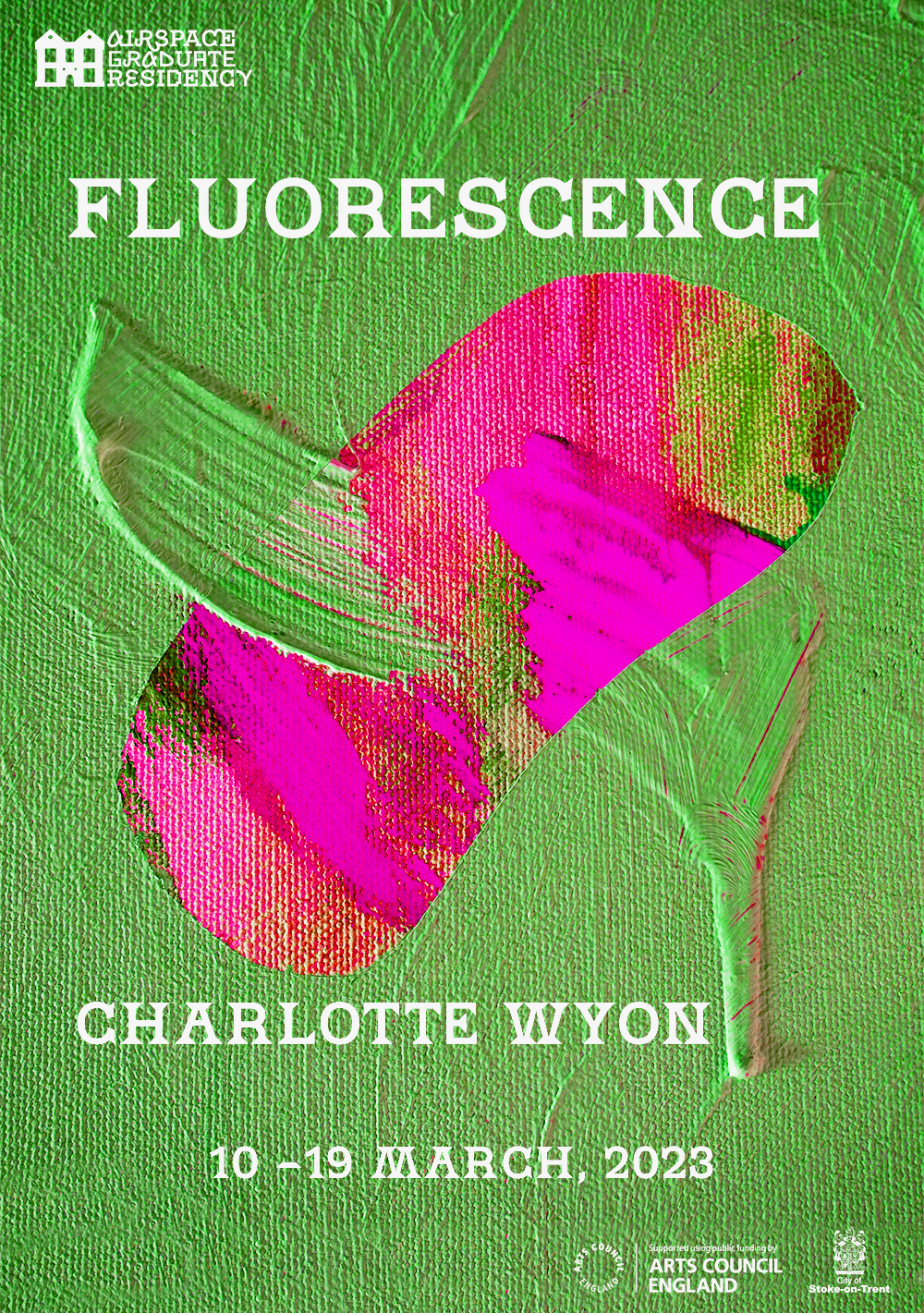
FLUORESCENCE
CHARLOTTE WYON
10 - 19 MARCH, 2023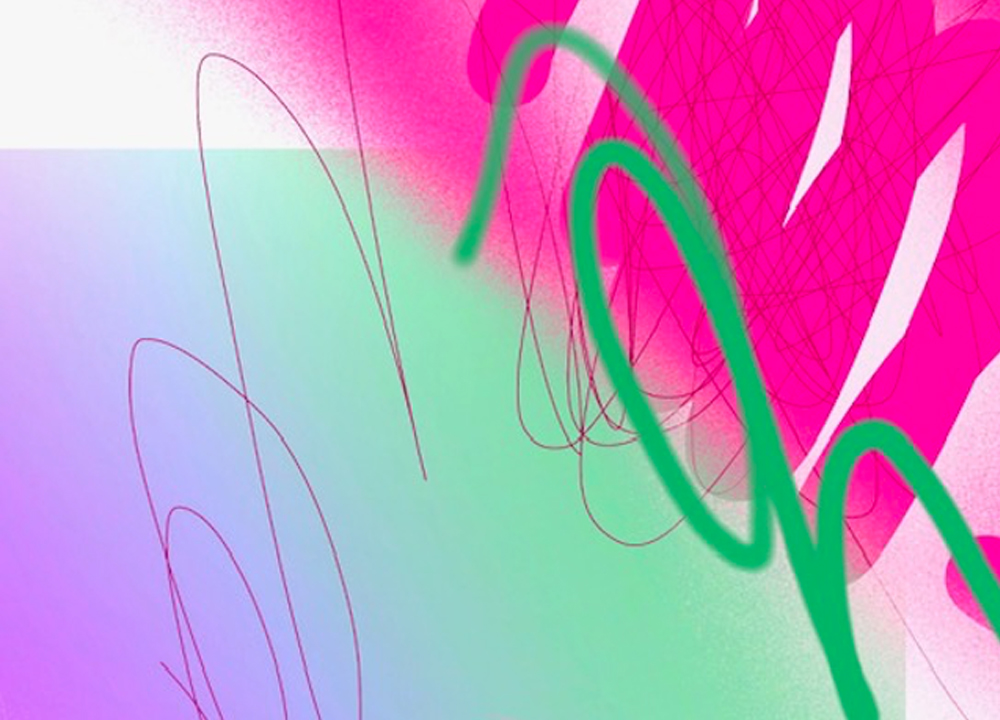
The final of three Graduate residency exhibitions sees Charlotte Wyon present FLUORESCENCE a mash-up of traditional and digital paintings.
‘Fluorescence’, Charlotte’s first solo exhibition concludes her Graduate Residency at Airspace. The exhibition presents an investigation into the relationship between physical and digital art in the form of colorful abstract paintings, digital works and instillations. The artworks play with the dynamics between the two distinct mediums’ visual imagery, processes and tools.
The works present a visual display of how different recognizable features of traditional, physical art and digital art interact. This is shown in the composition design and mimicking of techniques, such as digital art software tools and effects made in physical painting methods and mediums and vice versa.
The format of layers within a digital work and use of ‘undo’ and the erase tool are key features within digital art software and design processes; allowing for flexible and reversible manipulation that traditional, physical methods and mediums don’t. Similarly, digital art software tools strive to mimic effects of physical art mediums such as texture. The continuous development and experimentation within both mediums, especially in relation to each other creates tension, presenting an ambiguity around the identity and artistic process. This is further heightened by the addition of AR technology, where the viewer can add an additional layer to reality in the form of digital artwork viewed through their own screen, such as a phone. The multi-medium layered installation of combined digital and physical art mirrors the combined physical and digital art influenced compositions and furthers their interconnected relationship. The active engagement the viewer partakes in when viewing the exhibition prompts a deeper consideration of the mediums’ relationship.
The bold colour palettes and range of surfaces within this body of work display both traditional painting roots and associations with the glow and light of screens and technology which creates a presence and energy reminiscent of fluorescence.
REVIEW by ANNEKA FRENCH
There has been discussion centred upon the expanded field of painting for the best part of a century. While much of this discourse is related to the sculptural possibilities of painting, artist Charlotte Wyon is aiming to reinvigorate the conversation with a practice that combines the physical qualities of paint on flat surfaces with the radical possibilities of the digital. Her exhibition Fluorescence at AirSpace Gallery features seventeen paintings that can be visited within the three-dimensions of the gallery alongside multiple other works that are encountered digitally through the AR app Artivive on a mobile phone or tablet at the gallery. Drawing out the Covid-19 context of production, in which Wyon was limited to home-based practice during a portion of her undergraduate studies, and the ubiquity of the digital exhibition offers put forward by almost every gallery and museum during this period, Wyon has developed an innovative way of accessing a physical and digital exhibition via two parallel sensory experiences. Digital technology is here a means to unlock a ‘mini exhibition’, as the artist describes it, connected to each physical painting on display.
Fluorescence begins in AirSpace Gallery’s window, where an acrylic painting on canvas is hung next to Artwork_03230407, an acrylic painting on transparent Perspex. This is the first time that Wyon has used Perspex in a finished work. The material enables the reverse of the painting, support and its specific, initial brush marks to be seen from behind, with a view through into the gallery beyond when it is seen from the front. The materials of Artwork_03230407 mimic something of the computer, TV and mobile phone screens on which we are all so reliant, and hint towards the layering that can be found via the app and physical layers of paint elsewhere in the exhibition. In the gallery proper are a group of further wall-mounted paintings made in acrylic or acrylic and spray paint on canvas and on Perspex. Wyon’s painterly approach mixes expressive and gestural mark making, filled with energy and visible brush marks that contain something of the spirit of Jadé Fadojutimi’s work, particularly in the forest-like Artwork_0220231243 (all works 2023), with marks which are more graphic in style, akin to graffiti tags or a child’s first attempts at writing. The latter is emphasised largely in the works that can be found toward the rear of the exhibition space. Wyon’s more solid, flatter, rounded marks are heavily reminiscent of the movements our fingers make across shiny screens, scrolling online and inputting passcodes, or the tracks of a computer cursor navigating different forms of software, here connecting the work to the digital realm even before the AR app is accessed.
Wyon’s painterly working processes start with colour and, she explains, with an atmosphere or ‘vibe’ she wants to create. She usually has several pieces that she works on simultaneously in the studio, allowing familiar marks and her selected colour palette to feed into each painting because they are made with a view to being hung near one other. This, her first solo exhibition, is the first time that Wyon has been able to view this many of her works together at the same time, the large gallery space affording her the opportunity to experiment ambitiously with the physical paintings and their connected digital content. While working, Wyon stops between each layer of paint, allowing her to reflect and plan for the next one. Marks are rubbed back to enable earlier layers to show through; sections are masked off with tape to create clean lines and elements are sometimes literally cut and pasted back on to canvas surfaces. The layering of washes of colour, thicker applications of paint and fine sprays in typically vibrant and neon colours, pink and green being prominent, create iridescent qualities in some of the works on show. There is a feeling of restlessness. The neon pigment and neon Perspex cast a mirrored neon glow on the white walls and even on the viewer as they move in close to look. Each manual action echoes those that Wyon performs on Procreate, the software on which she makes the digital pieces.
The digital and AR elements of the exhibition are not an add-on but are central to Wyon’s thinking. This is evident not only in the planning of each painting on display, including colour and mark testing, and the documentation of different stages of the physical painting process and within the very many digital stills and animations that she has produced. She writes ‘the viewer scan[s] the work and receiv[es] it back within an altered landscape.’ Ostensibly, when one of Wyon’s paintings is viewed through the Artivive app, a series of additional digital artworks are accessed, transposed on to the gallery walls near to or overlapping with the physical works, revealing new digital paintings in one full surface or a series of separate fragments, and animated paintings that zip through slides and varying iterations like a quick-cut online ad. There are instances where new digital layers are added on to the physical paintings and instances where elements of the physical paintings are removed, revealing prior stages in the making of the physical work, as in Artwork_0220230217, in which the first thin washes of paint partially visible in the finished painting can be seen in full digitally. Here Wyon incorporates not only new works and alternative works but also the same works as they existed at an earlier date, opening up the possibilities of this technology to creatively interpret time as well as the three-dimensional space of the gallery. The importance of time is indicated by the title of each artwork, named for the date it was started and the time it was completed. As these types of technology progress and access to it for artists and the wider public expands, there will be new prospects for Wyon to continue to develop her practice in this digital area, an area that compliments the physical aspects of her overall painting practice well.
Anneka French is an independent curator and critic. She contributes to Art Quarterly, Burlington Contemporary and Photomonitor, and has had writing and editorial commissions for the Turner Prize, Fire Station Artists’ Studios, TACO!, Photoworks+ and Grain Projects. She worked as Co-ordinator and then Director at New Art West Midlands, as Editorial Manager of contemporary art magazine this is tomorrow and has worked at Tate Modern, Ikon, The New Art Gallery Walsall and Wolverhampton Art Gallery. French has curated exhibitions at Grand Union, Birmingham; KH7 ArtSpace, Aarhus, Denmark and Coventry Biennial. Her publication Gently Bumping was published in 2022.
Charlotte Wyon is an abstract painter concerned with themes of communicative behaviours, technology and the process of painting. Her work incorporates bold colour palettes and gestural mark making, with layers forming a significant part of her process. Shes based in Staffordshire while partaking in this residency since graduating from Arts University Bournemouth with a BA (HONS) Fine Art degree.
Previous work has explored behaviors surrounding technology and communication, specifically the use of technological devices and digital platforms when communicating, resulting in the development of habits and repetition. This led to current interest in themes involved with the nuance of visual communication using digital art software, and its relationship as a medium to traditional and physical painting.
Charlotte is interested in the active engagement of the viewer within her work and how the accessibility of technology can transform the context, scale and ownership of artwork. This ambiguity and change of control are something Charlotte draws upon when considering traditional, physical and digital art’s relationship and forming creation processes and composition designs.
Each year, AirSpace Gallery’s Graduate Residency Programme offers two new graduates a fantastic opportunity to be part of an exciting and innovative artist-led space in Stoke-on-Trent, providing 6 months free studio space, ongoing professional development support, mentoring and guidance in those crucial first months out of higher education, and an end-of-residency solo exhibition. Now into its 8th instalment, the residency programme is an attempt to tackle and highlight a problem with graduate retention in the city, offering early stage professional development support to artists.
‘Fluorescence’, Charlotte’s first solo exhibition concludes her Graduate Residency at Airspace. The exhibition presents an investigation into the relationship between physical and digital art in the form of colorful abstract paintings, digital works and instillations. The artworks play with the dynamics between the two distinct mediums’ visual imagery, processes and tools.
The works present a visual display of how different recognizable features of traditional, physical art and digital art interact. This is shown in the composition design and mimicking of techniques, such as digital art software tools and effects made in physical painting methods and mediums and vice versa.
The format of layers within a digital work and use of ‘undo’ and the erase tool are key features within digital art software and design processes; allowing for flexible and reversible manipulation that traditional, physical methods and mediums don’t. Similarly, digital art software tools strive to mimic effects of physical art mediums such as texture. The continuous development and experimentation within both mediums, especially in relation to each other creates tension, presenting an ambiguity around the identity and artistic process. This is further heightened by the addition of AR technology, where the viewer can add an additional layer to reality in the form of digital artwork viewed through their own screen, such as a phone. The multi-medium layered installation of combined digital and physical art mirrors the combined physical and digital art influenced compositions and furthers their interconnected relationship. The active engagement the viewer partakes in when viewing the exhibition prompts a deeper consideration of the mediums’ relationship.
The bold colour palettes and range of surfaces within this body of work display both traditional painting roots and associations with the glow and light of screens and technology which creates a presence and energy reminiscent of fluorescence.
REVIEW by ANNEKA FRENCH
There has been discussion centred upon the expanded field of painting for the best part of a century. While much of this discourse is related to the sculptural possibilities of painting, artist Charlotte Wyon is aiming to reinvigorate the conversation with a practice that combines the physical qualities of paint on flat surfaces with the radical possibilities of the digital. Her exhibition Fluorescence at AirSpace Gallery features seventeen paintings that can be visited within the three-dimensions of the gallery alongside multiple other works that are encountered digitally through the AR app Artivive on a mobile phone or tablet at the gallery. Drawing out the Covid-19 context of production, in which Wyon was limited to home-based practice during a portion of her undergraduate studies, and the ubiquity of the digital exhibition offers put forward by almost every gallery and museum during this period, Wyon has developed an innovative way of accessing a physical and digital exhibition via two parallel sensory experiences. Digital technology is here a means to unlock a ‘mini exhibition’, as the artist describes it, connected to each physical painting on display.
Fluorescence begins in AirSpace Gallery’s window, where an acrylic painting on canvas is hung next to Artwork_03230407, an acrylic painting on transparent Perspex. This is the first time that Wyon has used Perspex in a finished work. The material enables the reverse of the painting, support and its specific, initial brush marks to be seen from behind, with a view through into the gallery beyond when it is seen from the front. The materials of Artwork_03230407 mimic something of the computer, TV and mobile phone screens on which we are all so reliant, and hint towards the layering that can be found via the app and physical layers of paint elsewhere in the exhibition. In the gallery proper are a group of further wall-mounted paintings made in acrylic or acrylic and spray paint on canvas and on Perspex. Wyon’s painterly approach mixes expressive and gestural mark making, filled with energy and visible brush marks that contain something of the spirit of Jadé Fadojutimi’s work, particularly in the forest-like Artwork_0220231243 (all works 2023), with marks which are more graphic in style, akin to graffiti tags or a child’s first attempts at writing. The latter is emphasised largely in the works that can be found toward the rear of the exhibition space. Wyon’s more solid, flatter, rounded marks are heavily reminiscent of the movements our fingers make across shiny screens, scrolling online and inputting passcodes, or the tracks of a computer cursor navigating different forms of software, here connecting the work to the digital realm even before the AR app is accessed.
Wyon’s painterly working processes start with colour and, she explains, with an atmosphere or ‘vibe’ she wants to create. She usually has several pieces that she works on simultaneously in the studio, allowing familiar marks and her selected colour palette to feed into each painting because they are made with a view to being hung near one other. This, her first solo exhibition, is the first time that Wyon has been able to view this many of her works together at the same time, the large gallery space affording her the opportunity to experiment ambitiously with the physical paintings and their connected digital content. While working, Wyon stops between each layer of paint, allowing her to reflect and plan for the next one. Marks are rubbed back to enable earlier layers to show through; sections are masked off with tape to create clean lines and elements are sometimes literally cut and pasted back on to canvas surfaces. The layering of washes of colour, thicker applications of paint and fine sprays in typically vibrant and neon colours, pink and green being prominent, create iridescent qualities in some of the works on show. There is a feeling of restlessness. The neon pigment and neon Perspex cast a mirrored neon glow on the white walls and even on the viewer as they move in close to look. Each manual action echoes those that Wyon performs on Procreate, the software on which she makes the digital pieces.
The digital and AR elements of the exhibition are not an add-on but are central to Wyon’s thinking. This is evident not only in the planning of each painting on display, including colour and mark testing, and the documentation of different stages of the physical painting process and within the very many digital stills and animations that she has produced. She writes ‘the viewer scan[s] the work and receiv[es] it back within an altered landscape.’ Ostensibly, when one of Wyon’s paintings is viewed through the Artivive app, a series of additional digital artworks are accessed, transposed on to the gallery walls near to or overlapping with the physical works, revealing new digital paintings in one full surface or a series of separate fragments, and animated paintings that zip through slides and varying iterations like a quick-cut online ad. There are instances where new digital layers are added on to the physical paintings and instances where elements of the physical paintings are removed, revealing prior stages in the making of the physical work, as in Artwork_0220230217, in which the first thin washes of paint partially visible in the finished painting can be seen in full digitally. Here Wyon incorporates not only new works and alternative works but also the same works as they existed at an earlier date, opening up the possibilities of this technology to creatively interpret time as well as the three-dimensional space of the gallery. The importance of time is indicated by the title of each artwork, named for the date it was started and the time it was completed. As these types of technology progress and access to it for artists and the wider public expands, there will be new prospects for Wyon to continue to develop her practice in this digital area, an area that compliments the physical aspects of her overall painting practice well.
Anneka French is an independent curator and critic. She contributes to Art Quarterly, Burlington Contemporary and Photomonitor, and has had writing and editorial commissions for the Turner Prize, Fire Station Artists’ Studios, TACO!, Photoworks+ and Grain Projects. She worked as Co-ordinator and then Director at New Art West Midlands, as Editorial Manager of contemporary art magazine this is tomorrow and has worked at Tate Modern, Ikon, The New Art Gallery Walsall and Wolverhampton Art Gallery. French has curated exhibitions at Grand Union, Birmingham; KH7 ArtSpace, Aarhus, Denmark and Coventry Biennial. Her publication Gently Bumping was published in 2022.
Charlotte Wyon is an abstract painter concerned with themes of communicative behaviours, technology and the process of painting. Her work incorporates bold colour palettes and gestural mark making, with layers forming a significant part of her process. Shes based in Staffordshire while partaking in this residency since graduating from Arts University Bournemouth with a BA (HONS) Fine Art degree.
Previous work has explored behaviors surrounding technology and communication, specifically the use of technological devices and digital platforms when communicating, resulting in the development of habits and repetition. This led to current interest in themes involved with the nuance of visual communication using digital art software, and its relationship as a medium to traditional and physical painting.
Charlotte is interested in the active engagement of the viewer within her work and how the accessibility of technology can transform the context, scale and ownership of artwork. This ambiguity and change of control are something Charlotte draws upon when considering traditional, physical and digital art’s relationship and forming creation processes and composition designs.
Each year, AirSpace Gallery’s Graduate Residency Programme offers two new graduates a fantastic opportunity to be part of an exciting and innovative artist-led space in Stoke-on-Trent, providing 6 months free studio space, ongoing professional development support, mentoring and guidance in those crucial first months out of higher education, and an end-of-residency solo exhibition. Now into its 8th instalment, the residency programme is an attempt to tackle and highlight a problem with graduate retention in the city, offering early stage professional development support to artists.